
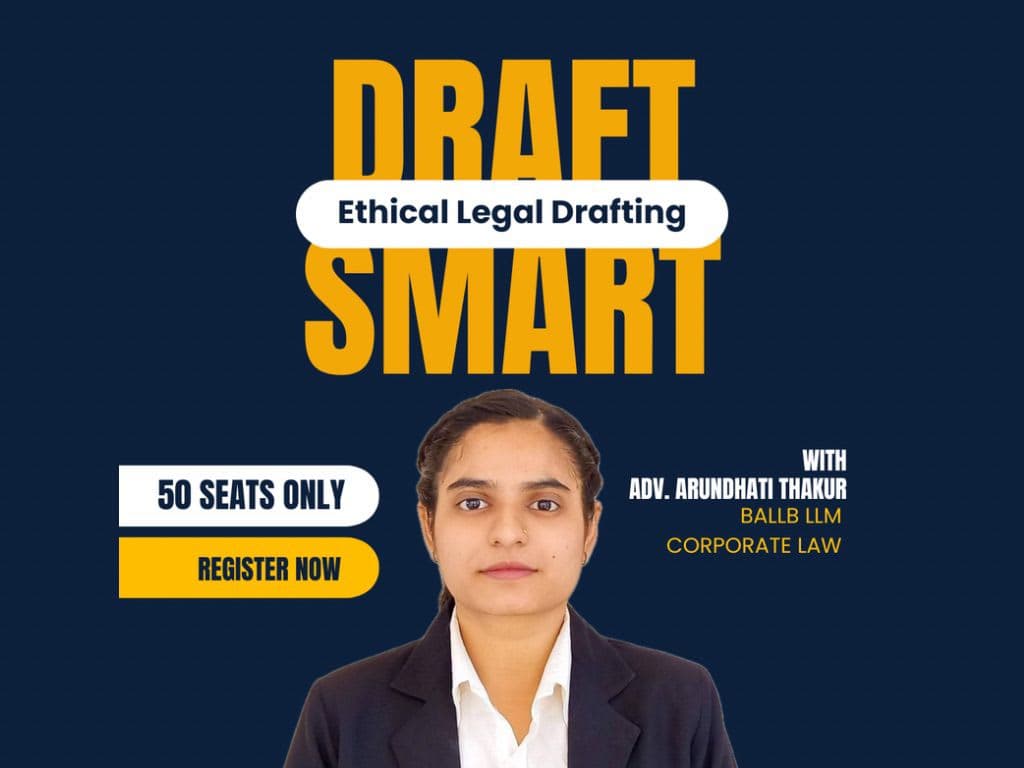
DraftSmart: Ethical Legal Drafting with AI
This course offers a practical and structured introduction to legal drafting in the age of Artificial Intelligence.
Program Introduction
Program Overview
Draftsmart offers practical learning on how to draft with the assistance of Artificial Intelligence. As AI tools become increasingly integrated into legal practice, it is essential for law students and young lawyers to adapt to this technology, while maintaining the effectiveness, ethical bounds and professional standards. The course focuses on leveraging AI as an assistive drafting tool, not a replacement for legal skill. This session is ideal for students who want to draft smarter, think deeper, and stay future-ready.
TOPICS IT WILL COVER –
- Human Judgment vs AI Assistance
- Drafting of Complaints, Notices, Plaints etc. Using AI Tools
- Editing, Proofreading & Legal Accuracy
- Professional standards that revolve around AI’s use in law field
- Case Study based teaching
Meet Your Mentor: Adv. Arundhati Thakur
Advocate Arundhati Thakur is a B.A. LL.B. graduate and an LL.M. (Corporate Law) scholar at IILM University, Greater Noida. She brings hands-on experience in legal research, teaching, and structured legal writing, with a keen focus on how AI can be used responsibly to enhance legal drafting—without compromising legal reasoning or ethics.
.She has authored the published paper “Opacity, Equality and Political Finance: Evaluating the Supreme Court’s 2024 Verdict on Electoral Bonds” in the LawFoyer International Journal of Doctrinal Legal Research and has an upcoming international publication on ICC–ICJ non-enforcement and global power asymmetries. Her academic and conference engagements reflect a strong focus on constitutional values, democratic accountability, and global governance, which meaningfully shape her research and drafting approach.